
Fully funded is the most stretched phrase in scholarship search. One list uses it for an award that covers tuition and stops there, the next for one that pays tuition, housing and flights, and a student comparing the two cannot tell them apart. Our explainer on what fully funded actually covers defines the term part by part. This article does the other job: it counts. We read the funding wording of all 494 scholarships in the StudyAbroadExperts dataset, the same records ScholarshipMatch matches students against, and tallied what the awards actually promise.
The headline count: 96 of 494
Of the 494 scholarships in the dataset, 96 carry a fully funded flag, about one in five. The flag is the dataset's own tag, derived from each award's funding wording when the records were collected. Read the same records more strictly and the number shrinks fast. Ninety awards state full tuition outright. Sixty-eight state a stipend. Only 37 state both: full tuition and a stipend in the same award. For scale, 248 of the 494 records carry a numeric award amount at all.
The gap between 96 and 37 is the point. Plenty of awards cover tuition and stop. Others pair a stipend with partial tuition. A further 14 records mention full tuition only as the ceiling of a partial to full range, and they are not inside the 90 counted above. When a listicle says fully funded without saying which test it used, it can be describing any of these.
Where fully funded scholarships for international students concentrate
China holds 43 of the 96 flagged records, and 19 of the 37 full packages. The pattern is a standard package repeated across government and university schemes: full tuition, a monthly stipend, accommodation and insurance, with the Chinese Government Scholarship as the template. Of China's 70 records in the dataset, 43 carry the flag. Australia follows with 12 flagged records and 6 full packages, and the United Kingdom with 10 flagged records.
The United States looks like the exception, and the exception teaches the limit of the count. The US is the largest pool in the dataset with 154 records, yet only 8 carry the flag and just one, Knight-Hennessy Scholars at Stanford, passes the strict full package test. American full funding usually arrives as need-based aid rather than a named package: 30 US records state that the college meets 100 percent of demonstrated financial need, and not one of the 30 carries the fully funded flag, because the wording never uses the phrase. Treat the 96 as a count of named full packages, not a census of every route to a free degree.
Who pays: universities first, governments second
Universities supply most of the dataset, 354 of the 494 records, and most of the flagged awards, 57 of the 96. Governments supply 89 records and 24 flagged awards, intergovernmental bodies 10 records and 9 flagged awards, and private and NGO funders 39 records and 6 flagged awards. Proportionally, government schemes are the denser source: 24 of 89 government records carry the flag, about 27 percent, against 57 of 354 university records, about 16 percent. The flagship state schemes are built as packages; university money is more often a tuition discount with a name.
The level picture: master's first, doctoral close behind
Degree levels are recorded across the dataset, and a single scholarship can name more than one level: 160 records include master's study, 143 include bachelor's study, and 121 include doctoral study. The flagged awards follow the same order: 45 include master's study, 37 include doctoral study and 27 include bachelor's study. At the strict full package test the order tightens: 28 of the 37 include master's study, 27 include doctoral study and 20 include bachelor's study. A bachelor's applicant faces the thinnest full package shelf in the data, while doctoral funding runs nearly as deep as master's funding despite a smaller pool.
Inside the 37: what a full package looks like
The strict test leaves 37 awards whose own wording promises full tuition and a stipend together. A few of them, stated the way their records state them:
- Chinese Government Scholarship (CSC), China Scholarship Council: full tuition, accommodation, a stipend of ¥2,500-3,500 a month, and medical insurance.
- Clarendon Fund Scholarship, University of Oxford: full tuition plus a living stipend.
- Knight-Hennessy Scholars, Stanford University: full tuition, a living stipend and academic costs for up to 3 years, the only US record in the 37.
- Australian Government Research Training Program: full tuition plus a living stipend of AUD $32,000 or more a year.
- Swedish Institute Scholarships for Global Professionals: full tuition, a monthly living stipend, a travel grant and insurance.
- DAAD Helmut Schmidt Programme, Germany: full tuition, a monthly stipend, travel and insurance.
- Commonwealth Scholarship, United Kingdom: full tuition, airfare, a living stipend and a thesis grant.
Every one of these still has to be checked on the provider's own page before you plan around it. Award wording is the provider's claim, recorded as published, and funding terms change between cycles.
How we counted
The counts were computed on October 27, 2026, over the award wording and funding flags of all 494 records in the ScholarshipMatch dataset. "States full tuition" means the award text promises full tuition, or 100% tuition, as the award itself; the 14 records that offer full tuition only as the top of a partial to full range are excluded from that count. "States a stipend" means the award text includes a stipend. "Full package" means an award passes both tests. The fully funded flag is the dataset's own tag, set from award wording when each record was collected, which is why it is broader than the full package test.
Run your own count
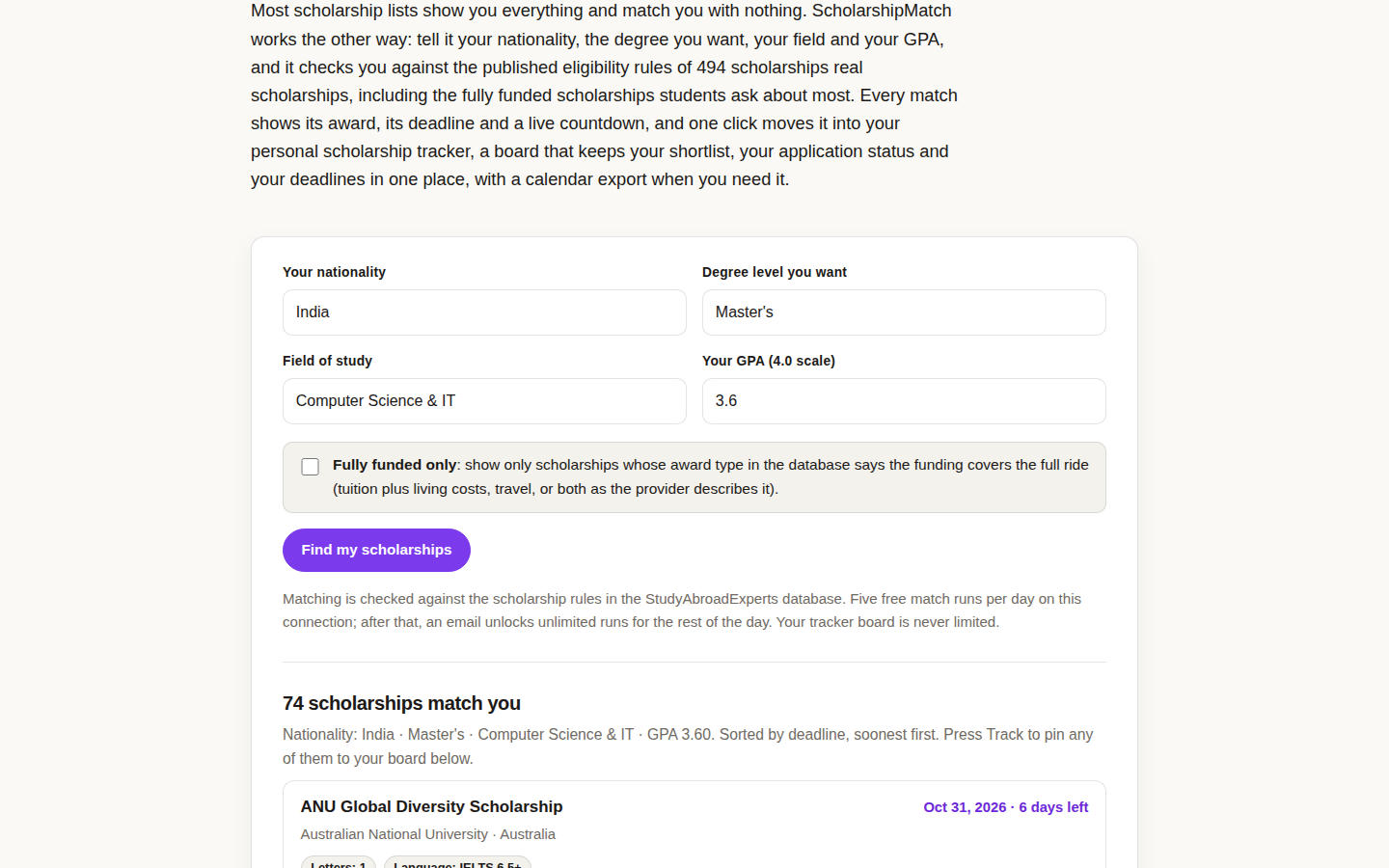
ScholarshipMatch has a fully funded only toggle that applies the flag live to your own profile: enter your nationality, degree level, field and GPA, and the matcher keeps only the flagged awards whose eligibility rules you meet. Five match runs a day are free on your connection; after that, an email unlocks unlimited runs for the rest of the day, and anything you pin to the tracker board stays free. Start with a filtered match run, keep the definitions from what fully funded actually covers beside it, and use the tracker workflow guide to run the search week to week.