
Fully funded scholarships are the scarcest money in this entire dataset, and scarcity changes what a mistake costs. Miss a document deadline for a partial award and you lose some money. Make the same mistake on a fully funded application and you lose the whole degree plan, because there is no second fully funded offer quietly waiting behind it.
How scarce is fully funded? 96 out of 494
Of the 494 scholarships in our dataset, 96 are tagged fully funded, about one in five. And they are concentrated in two ways most applicants never see. By provider: universities supply 57 of the 96, governments 24, intergovernmental bodies 9 and private or NGO providers 6. By country, the concentration is sharper still: China hosts 43 of the 96 fully funded entries, nearly half, ahead of Australia with 12 and the United Kingdom with 10.
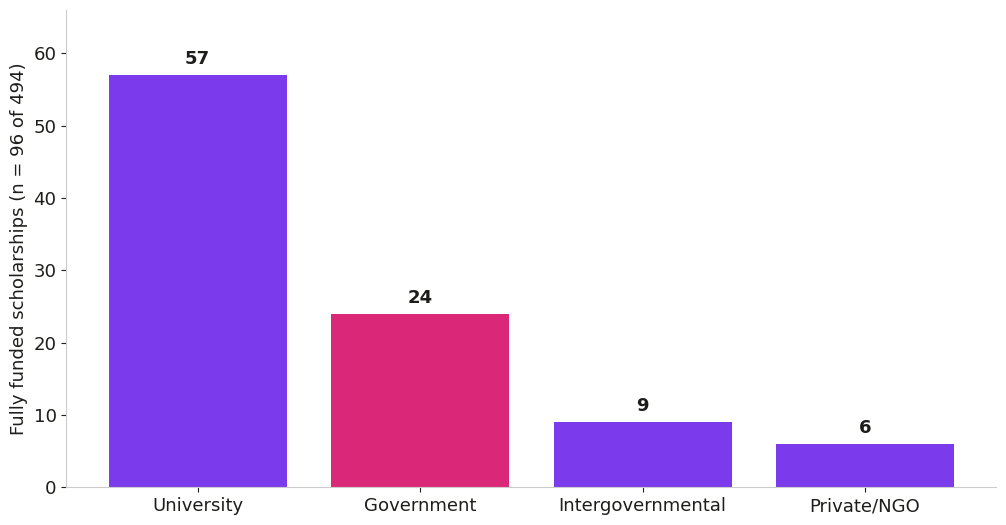
That provider split matters more than any application tip. The famous government schemes are only a quarter of the fully funded pool. The other three quarters sit inside universities, where they are advertised on department pages instead of national portals, and where the competition is everyone applying to that university rather than everyone in your country. Mistake number six below is the expensive one.
The 7 mistakes, priced against the fully funded pool
1. Missing the deadline over time zones. Flagship scholarships close on the provider's clock, not midnight your time, and a fully funded scheme will not reopen for you. 2. Reusing an SOP without tailoring. Committees smell templates in the first paragraph, and fully funded panels read fewer, stronger files. 3. Asking for recommendations a week before. Professors need three weeks, and a rushed letter reads like one. 4. Ignoring eligibility fine print. Two years of work experience can mean 2,800 documented hours; with only 96 fully funded seats in the dataset, fine print is where most files quietly die. 5. Applying to exactly one scholarship. Five or more applications, or you are buying a lottery ticket. 6. Skipping university scholarships. The data above is the rebuttal: 57 of 96 fully funded awards are university money, the least hunted money in the pool. 7. Forgetting the money proof. Some scholarships want financial documents alongside the application itself, and a missing document is a closed file.
Why these mistakes are so common: the data invites them
Part of the blame sits with the information itself. Across all 494 scholarships in our dataset, only 185 publish a deadline in a form a machine can read. The rest describe timing in prose, in PDFs, or on pages that change without notice, which is how mistake number one happens to careful people. Recommendation letters, the subject of mistake number three, are specified in 238 of the 494 entries, so the three week rule is not an edge case; it applies to roughly half of everything you will apply to. When the underlying data is this patchy, the students who win are not the ones with the best memory. They are the ones with a matched list, a calendar, and documents prepared before the season opens.
Play the pool that actually exists
The strategy follows from the counts. Build your list from the full 96, not from the famous ten. Weight university schemes heavily, because that is where the seats are. Treat China as a first class option if your field fits, because 43 fully funded entries is not a footnote, it is nearly half the pool. And start from an eligibility matched list rather than a fame ranked one: our rundown of the best scholarships for international students in 2027 shows how quickly the map narrows once filters bite, and the finder apps comparison shows which tools filter honestly.
Get the matched list before the season opens
ScholarshipMatch hand-matches your profile against all 494 scholarships in this dataset, fully funded flags included, with deadlines attached, for $9.99 one-time per search. Each of these mistakes costs a year, not a week. A matched list costs less than one missed deadline.
None of these seven mistakes is about talent. Every one of them is about timing, documents and reading the fine print, which is good news: they are all fixable with a calendar, a checklist and a list that was matched to you before the season started.
Sources: EducationUSA